

adrian brown
-
Posts
687 -
Joined
-
Last visited
adrian brown's Achievements

Heavyweight Boxer (5/6)
-
Bicycle riding and concertina playing re: Pain
adrian brown replied to richard's topic in General Concertina Discussion
The Netherlands has a relaxed attitude to bicycle riding, you should try one that we call an Omafiets over here, they are very comfortable to ride and put no pressure on your hands. Of course it is possible to do both at the same time... Adrian
-
Reel St Jean - concertina + (unreal) string quartet
adrian brown replied to RatFace's topic in Concertina Videos & Music
Very nice - I really like this! Adrian -
I was at the cinema last night for the latest (and possibly the last) Indiana Jones film and I'm pretty sure I heard an English or possibly even a duet in the "boat" scene. The actor appeared to be playing a single row melodeon, but the sound was pure concertina. Anyone here notice this, or was possibly the player? Adrian
-
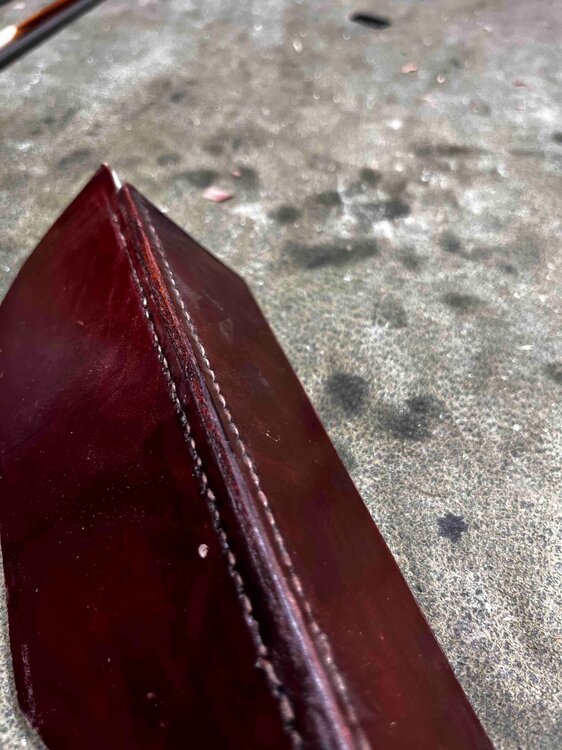
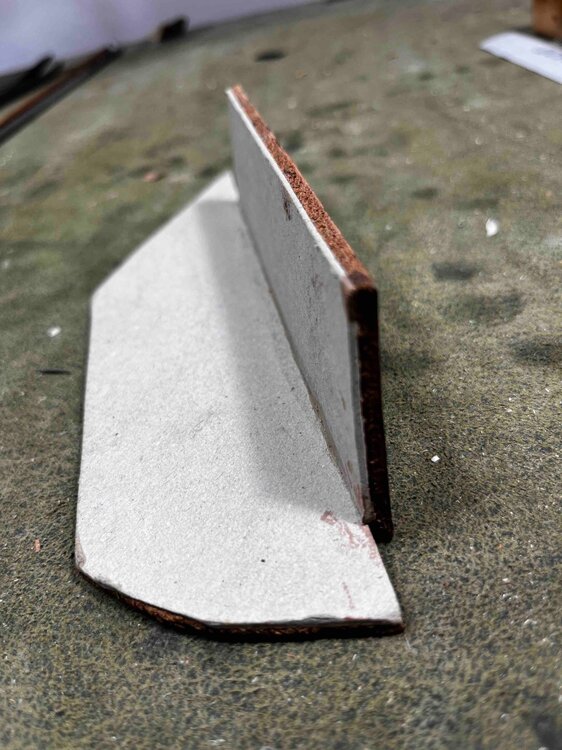
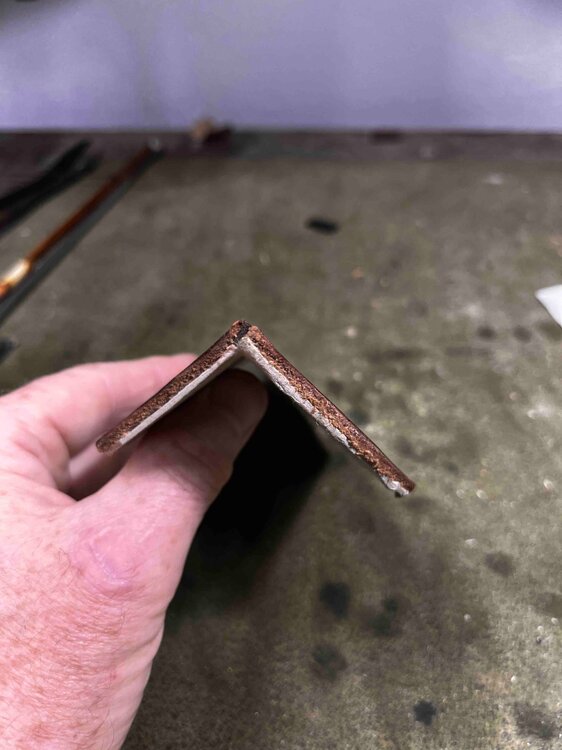
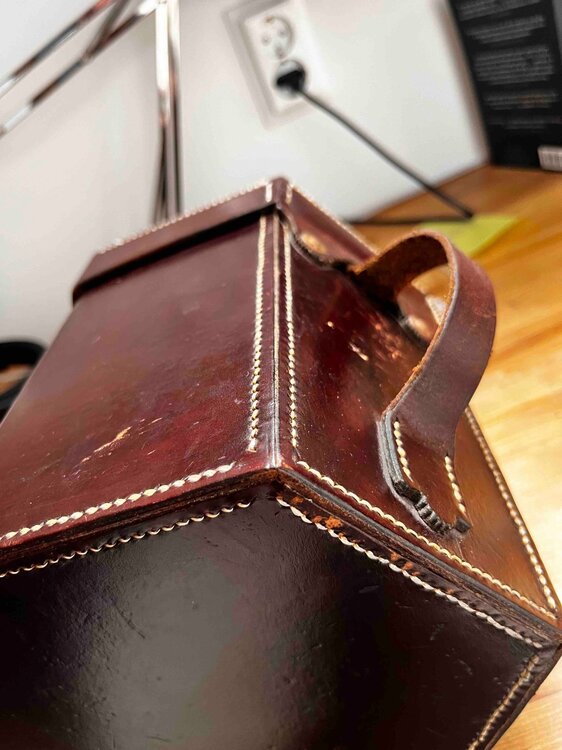
I found one of my early test strips in the workshop which will hopefully show my stitching method a little clearer: You can see the relative thickness of the card and leather - as I said in an earlier post, the magic ingredient is the hide glue (rabbit skin) which stiffens the laminate leather/card amazingly. You can see here that the stitching doesn't really go into the card With the jug cases, the most difficult stitching is on the side panels as the angles are much wider than 90°, so the needle goes in at a very oblique angle. In all this stitching, it's really important not to pull the threads too tight, as you can simply pull the thread through the leather. Adrian
-
My baritone Anglo goes to cello C, two octaves below middle c, but then the bottom octave is diatonic apart from the Bb. With Anglos and Duets you can't have everything, or you'd end up with a beast the size of a Chemnitzer. If you want to play solo classical music that is basically in one or two parts, with the odd bit of double-stopping, surely the English is the best way to go? I think the limitation with the English is that with more than two parts, it gets pretty unmanageable fingering wise, but I am prepared to have my head blown off here:-) Because all the notes are there if you want to play a Bach fugue on one of the larger sizes? Adrian
-
Hi Alex and DDF, Great work! DDF: when I made my cases, I punched the holes when the pieces were flat on the bench, with their cardboard backing already glued on, but before bending the sides. It looks like Alex has stitched his leather to the the already jointed box, so yes, I agree the pricking iron would probably demolish the box unless you supported it somehow on the other side. With the Jeffries cases, the stitching goes between the leather panels, so on the ends, it's going through the joint at an angle of about 45° and hardly touching the card on the inside. Using Alex's technique, it looks like the stitching is closer to 90° from the surface, so the leather is joined to the wood construction, rather than (in the case of the Jeffries cases), to the corresponding leather panel. How is it on the Wheatstone style cases you made? I've never had one of those apart enough to see how the stitching goes, put given the proximity of the stitching to the edge of the joints, I suspect it is more like the Jeffries cases, than how Alex has done it? Alex - I'm not saying one way is better than the other, I'm just interested to know how it was done in the past with a wooden as opposed to a card liner? This would have implications for how Steve approaches it, since covering a wooden box with leather would need very different planning than constructing a box from a composite material of leather/card or leather/wood.
-
William Byrd - Sermone Blando
adrian brown replied to adrian brown's topic in Concertina Videos & Music
Thanks! One like this? I've always fancied having a go at making one of these - it would really combine my twin interests of pipes and reeds 🙂 Adrian -
Hi Steve, As Chris said, I have made a few of the Jeffries style jug cases as well as repaired of few Wheatstone cubes. There's a thread from a few years ago here: It sounds as though you are using the right approach - you really need to test your technique at every step of the way before you ruin a nice piece of leather, or destroy the project at the last seam 🙂 I found a the videos by Nigel Armitage very helpful too, but it was nothing like getting to grips with a mock up joint. The Jeffries cases have cardboard stiffener on the inside and as you say, the Wheatstone ones have thin wood. In both cases 🙂 an important part of the stiffness comes from the hide glue - it's truly amazing how this works once it is dry. Other than that a good pricking iron is essential to get your stitching straight and it would help to make up a jig that holds the pieces to be joined in place, while stitching. Nigel shows one of these in his box stitching video and it really helps. Otherwise send me a pm Steve and I'll try to help. Adrian
-
William Byrd - Sermone Blando
adrian brown replied to adrian brown's topic in Concertina Videos & Music
Dammit - how could I have missed that - a day too early 🙂 Thanks for pointing it out Dave! -
With the days getting shorter in the northern hemisphere, and only 174 shopping day until Christmas, maybe time for a short, cozy piece to keep away the winter's chill… I wanted to do this in our local church, but it’s not possible to get in for an evening recording, so some artificial reverb will have to suffice for the atmosphere. Adrian
-
post-Brexit shipping
adrian brown replied to Wolf Molkentin's topic in General Concertina Discussion
Hi Stephen, Is the e-bay shipping cost decided by the individual seller, or is is set by e-bay on a per kilo and destination basis? Of course all companies and individuals are going to have their own tariffs and conditions, but the ones I've dealt with in NI seem to be very keen to exploit their unique status of being both within the UK and the single market. -
post-Brexit shipping
adrian brown replied to Wolf Molkentin's topic in General Concertina Discussion
Hi Wolf, (and Gregor) One thing I have been doing over the last year or so is to find suppliers of British goods in Northern Ireland, (in my case it's mostly tools and machine parts in imperial sizes that I can't find in the EU). Since Northern Ireland has this funny status of still being inside the single market, they can simply deal with the VAT as any other EU country would, and so there are no customs checks or formalities. As a consequence, the shipping is much faster and smoother than sourcing the same products from a UK supplier. I understand that Northern Ireland is enjoying something of a booming economy at the moment, I guess because of its continued ability to trade seamlessly with the EU. Cheers, Adrian -
1/4-comma meantone calculation for Anglos
adrian brown replied to Luke Hillman's topic in General Concertina Discussion
Without wishing to get too pedantic, I feel I should point out that in this example, the instrument is not at A=440Hz, but at A=439.41Hz, making the whole instrument slightly flat of concert pitch. If this can be considered negligible, it begs the question of why you wouldn't simply use the A reference in the first place? I agree Little John, but again I feel I should point out that you can put the wolf anywhere, independently of where you set your reference note. In this example, D is the reference and so G# is directly opposite in the circle of fifths, rather than the Eb, if you start from A. However, there's nothing to stop you going only 2 fifths in one direction and 10 in the other. You can use a reference D and still have Eb as the biggest discrepancy if you so wish. Lastly, where you decide to put the wolf and by extension which notes you would like enharmonic alternatives for, depends first on which chords you regularly use. In my own case, I opted for enharmonic Eb/D#s because I was fed up with having to choose between a clean C minor or B major chord, and wanted them both... Adrian -
1/4-comma meantone calculation for Anglos
adrian brown replied to Luke Hillman's topic in General Concertina Discussion
Thanks Clive, I think that outside of the obvious clashes I highlight in the video, that occur when you push to the limit of meantone tuning, there's probably much less in it than a lot of people think. You can certainly get used to either, or both and it certainly shouldn't be something that gets in the way of the music! As I pointed out in the video, it rather depends on the sort of repertoire you want to play. In folk and pop music where parallel fifths are quite acceptable, the cleaner fifths you get with ET is probably a better option. In Renaissance and Baroque music where thirds were a consonant interval, and parallel fifths an aberration, MT is the obvious choice. Adrian -
1/4-comma meantone calculation for Anglos
adrian brown replied to Luke Hillman's topic in General Concertina Discussion
Probably best to simply share my calculations. A. Meantone temperament calculations for anglo concertina.pdf