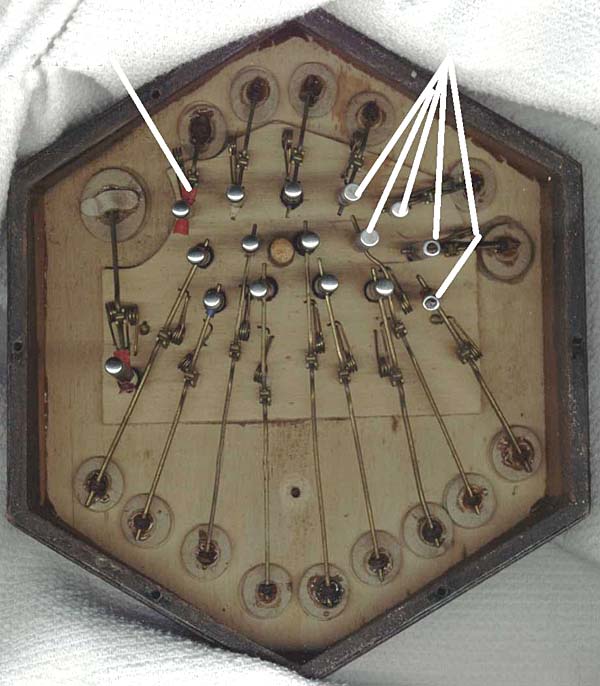
Pete Horan (Pjhrn49@aol.com) would like to know if anyone knows the story behind this Wheatstone anglo. It seems to be part old-style (good) and part late-model (bad). The reeds and reed frames look unusual, with their "crimped" ends and screwed-in attachments. The reed-pan looks rather unusual too, with a sort of semi-radial layout. Does anyone know anything about the reeds and other aspects of this model? It was apparently made in 1960, which would put it close to the beginning of B&H's takeover of the Wheatstone company.
Pete asks (Oct. 1999):
"It is an interesting one, indeed. The crimped-in reeds are quite unusual, and I can imagine problems which would develop over the years requiring re-crimping them. I would love to see the underside of one of those reeds, to see whether they did what I think they did in forming them."
From Pete Horan:
"I did hear from S Dickenson on the 'mystery wheatstone', in which he said it was a standard Boosey and Hawkes (and hence no mystery). The design was their attempt, as I think we had more or less surmised, to simplify and cut costs. The 'crimped' reeds are Wheatstone, though Steve added in his opinion "not entirely successful". It is however a true Wheatstone design."

