[more info and photos on the official Suttner Concertinas web site]
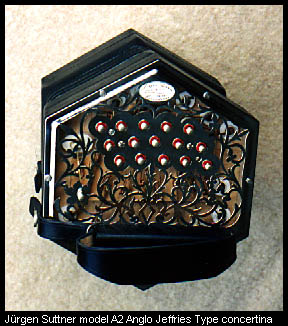
Jürgen Suttner in Germany makes some superb anglo concertinas. I wrote him a while ago and he sent me a nice brochure with prices and photos. He apparently uses modern machining techniques (he's a qualified toolmaker) combined with lots of hand-crafting which results in beautiful, rugged and very playable and fine-sounding instruments at a reasonable price. His model A2 31-button 7-fold black bellows silver-ended with sycamore/maple reed pan anglo pictured above (he says it's the most popular model for Irish music) is approx. $2500 US. I'd guess that postage should be approx. $100. Note that this is MUCH cheaper than the price listed for this model in the catalogs at Hobgoblin and Lark in The Morning, among others. In May 1997 Suttner said that delivery could be made in under a year. Delivery on new orders is now up to 4 years! Oh well -- I guess it's just a testimony to the quality and value of his instruments, but that's small consolation if you're looking for your first instrument NOW!
While in Seattle recently I had a chance to play Kevin Gow's Suttner anglo (thanks Kevin!). It was a 30-key C/G metal-ended Jeffries-type. If you've read my NHICS 1998 report you'll know that I wasn't necessarily enthralled with the Jeffries-type Suttner I tried there. I now think there were two reasons: 1: It was very new and not broken in. 2: I wasn't used to playing a Jeffries. Having only played a real Jeffries now since January, I have more of the control needed to get the most out of the instrument, which really is quite different from a Lachenal. Back at NHICS 98 I was used to playing a Lachenal, which is more forgiving and quiet compared to a Jeffries, which if played roughly or hard (or just poorly) will sound loud, harsh and not very pleasant. Now, I was able to play the Jeffries-Suttner like a Jeffries is supposed to be played (and, in all modesty, I think I'm a better player after attending NHICS!) and I can tell you that this was a very fine concertina and very nearly the equal of my C/G Jeffries. I was impressed. It didn't quite have the same "growl" that I love so much as my Jeffries, but in another 10 or 50 years, who knows! The action was smooth and fast (but not too loose), the sound was clear and loud and had that distinctive quality-concertina "honk" and the weight was, as far as I could tell, nearly identical to my Jeffries. The bellows were just right too for me -- not too "floppy" and firm enough that the ends didn't collapse or bend at all when played hard or fast. I really could play it like I play my Jeffries and almost forget that it wasn't actually my Jeffries. I still haven't tried a Dipper or Dickinson-Wheatstone yet so I still can't say "buy this one over that one", but I can now say in all honesty that the Suttner-Jeffries is a fine instrument and an excellent value. I'll be the first to admit that I'm still no expert, but for what it's worth, it's the first concertina I'll actually come right out and recommend now. Remember -- I'm not saying it's better than any other make or model, but I will say that if you like the idea of owning a Jeffries but can't afford the $4000-$5000 you're likely to pay for a fully-restored one or just can't find one, you'll be very happy with a Suttner and will not regret the purchase.
|
|
Ross Schlabach owns both Suttner and Jeffries anglos and had this to say (April 17, 1998):
"I have a 31 button C-G Suttner reproduction of a Wheatstone Linota. It is one of Jurgen's earlier instruments. But unlike most of his instruments you see around the US, it is wooden ended. Because of this it is quite mellow in sound. The metal buttons have a very nice action.
In case you are curious what it looks like, see the picture on Big Nick's Concertina Spotters Guide. He took the picture at the 1996 Squeeze-in at Bucksteep.
I also have a delightful 28 button Jeffries that was fully restored by Colin Dipper. It is faster and the action is lighter than the Suttner, but I would have to give the Suttner excellent marks for overall tone, tightness of the bellows, and overall quality. One other point. It is easy to over-squeeze a Jeffries which causes the sound to get harsh and the notes sound flatter the harder you play. To date I have not noticed the same thing in the Suttner, but it is quieter than the Jeffries regardless of how hard you squeeze.
[...]
Now that my Jeffries has been re-tuned to concert pitch, I do play it the most. Even though the Suttner's buttons and action are smoother, the Jeffries is more responsive -- and should be for the price difference! I will have had the Jeffries for two years come October. I bought it from Paul Groff in Cambridge, Massachusetts. Paul is an excellent concertina tuner and from time to time he imports instruments into the US. For the best quality instruments, I do not think there is anyone better to deal with than Paul.
Many people turn their noses up at 28 and 26 button instruments and I think they are making a big mistake. Having only 28 buttons does not seriously hamper me in playing at all. The C & G rows are normal. The top two buttons on the outside row on the left side of a 30 button concertina (G#/Bb and A/G) are shifted down one place (toward the floor as you hold the instrument normally). On the right, the top button on the outside row is omitted and the first button on that outside row is a C#/Eb. I dumped the Eb in favor of a draw C# to give me C# capabiilites in both directions as I would have with a 30 button. And the 26 button is just like the 28 button but it doesn't have the bottom outermost buttons on either side."
Feb, 28, 1999: Comments by Kevin Gow
"I play a Suttner Anglo. I have two friends who each have Dippers. One of the Dippers is 15 years old, and the other is about 2 years old. The newer Dipper is LOUD. In sessions where there have been up to 15 people playing, this new Dipper can be singled out. My Suttner is also loud, but not as much as the newer Dipper. The newer Dipper also has a harder (for lack of a better word) timbre making it more harsh-sounding. As far as the older Dipper, it sounds very much like the Suttner. I don't know if this is because it's been "broken in" or if it was made that way, but it's owner said it became that way over the years. The older Dipper still has a solid feel and plays well. The bellows is looser (broken in) than on the newer Dipper, and this makes it a comfortable instrument.
If you order, be sure to specify which notes you want for which buttons on the right-side third row. I ended up switching the G# and A in my Suttner. It only worked because the reed holders were very nearly the same size. Also, if you order a Suttner 31-button, it would be nice to have the left thumb button be a double-D if you're into Irish music."
July 30, 1998: An e-mail interview with Jürgen Suttner
1. How long have you been making concertinas and what made you start making them? Is this now a full-time business for you?"In the seventies I started to play English concertina. After a while repairs were necessary on my instrument and I tried to do them myself. Step by step the idea came to try and make a concertina completely by myself. I made my first concertina in 1980. In 1983 I started to make them in part-time business and since 1995 it is my full-time job."
2. Did you have a specific philosophy when you started out making anglos (price, construction, sound, action, etc...)?"My idea was to make concertinas according to the English makers, especially Jeffries and Wheatstone. I mean this in regard to sound and action. To reach the quality of their instruments it is necessary to follow their ways of construction."
3. Your instruments seem like a genuine value compared to vintage instruments (Lachenals, Jeffries, etc.). I recently had the opportunity to try one of your Linota models and found it to be a very nice instrument with great sound and action -- how do you keep the price down while maintaining such nice sound and construction?"I fixed the prices for my concertinas according to the market here in Europe. With increasing quality of my instruments it will certainly be necessary to raise the prices during the next years."
4. A number of people asked if you make everything yourself or if you have assistants or apprentices? In a related question, others have wondered why you don't "outsource" more of the construction in order to lower the delivery period which is currently quite high and a source of frustration for people looking for a high quality concertina as their first instrument NOW :-)"As well as the quality of the concertinas I always try to improve the productivity and to find ways to produce quicker. Since the beginning of this year I have a part-time assistant. I invested a lot in machines like a computer-controlled milling-machine. Outsourcing is not as easy as it sounds. It needs time of preparation. The parts I need are not available in shops, but every part has to be specially-made. Such parts are cheaper the more you order. The small numbers of pieces I need often mean incredibly high costs per piece. But I already oursourced some parts and hope to do more of it in the future. There is always a process of changing and improving and speed up the production."
5. For your Jeffries models (which I suppose are your most popular models, especially among the Irish music crowd), are they really a "copy" in terms of reeds and overall construction? How would you characterize them (in terms of action and sound at least) compared to vintage Jeffries anglos?"I copy the most important characteristic features of the Jeffries models. Some concertina players here in Germany made a blind test last autumn, one of them playing a good Jeffries and one of my Jeffries copies, and the other were supposed to find out which is which, but they didn't hear any difference. I have a customer in Ireland who sells his Jeffries models in order to buy concertinas from me."
6. Is there anything you'd like to say regarding your instruments, and especially in regards to how they fit into the range of other quality anglos out there like Wheatstones, Dippers, Connors, etc.? I'm obviously not asking you to say that "mine is better because", but more of a reflection on your design, construction and pricing considerations and philosophy..."My production concentrates mainly on Anglo concertinas, Wheatstone and Jeffries models in several sizes, tuning and end plates. Besides the Anglos I make few English models, but no duets, miniature or bass instruments."
7. What's your instrument of choice when you play? What kind of music are you most interested in?"Unfortunately I don't have much time to make music myself. I mainly play when I try the concertinas I currently make, that means I play Anglo most of all. The music I am most interested in is Irish traditional music."
Thanks Jürgen for taking some time out of your busy schedule to answer these questions.
juergen@suttnerconcertinas.com
Jürgen Suttner
Suttnerconcertinas
Gewerbestr. 26
D-57078 Siegen
Germany
Phone ++49 271 8706939
Fax ++49 2732 27161
