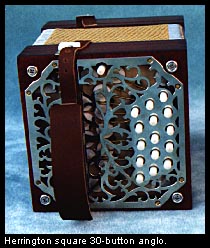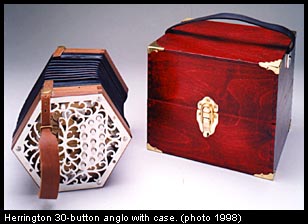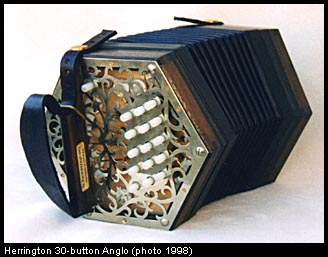
Texas-based Harold Herrington has spent the past ten years
perfecting what appears to be a beautiful, very well made, nice sounding
and reasonably-priced 30-button anglo concertina. For only US $1500, he'll make you a very nice-looking
concertina. He has developed a unique mechanism involving a lever and coil
spring which apparently results in a very reliable and fast action. Check
out his web site for more details.
Between Herrington, The Button Box (Trillium), Norman, and Marcus Music models, I'd say things are definitely
looking up for the serious concertina student on a budget!
"A lot has taken place since I last spoke to you. The concertina continues to evolve, with some significant simplifications in construction. The purpose of the changes was to improve efficiency in the construction process without a sacrifice in quality. I am now using special fixtures for construction of the reed pan, and the concertina body. It cuts construction time in half while making each reed pan and hexagonal body identical to the previous one. I was not aiming at interchangability of components, but arrived there rather by accident.The present size of both the C/G and the G/D is 6 1/8"- (155mm). I am considering going to a 6"- size (152mm), or even to a 5 7/8"-(149mm). I have also changed the way the mechanism is built. In early models I used a fixed stainless steel post, on which the button slid up and down. I have re-designed the mechanism to allow the stainless post to float. The post is now seated loosely in a socket in the action board. Its function is to keep the base of the button in the proper position, and to act as a spring guide. Where the button comes through the grill I have added a more or less standard bushing board. In the past I made buttons from either Delrin or ABS plastic, with a brass sleeve in the center. Now I have gone to a metal button turned from 18/8 stainless steel as my standard. These buttons are precision made, nicely finished, and very durable. Two thousand years from now some of these buttons may be found in a land fill, being all that remains of the concertina, and have some archaeologist scratching his head as to what they are.
The grill is now offered in stainless steel as well as German silver. The stainless grill was introduced for a customer that has a problem with his perspiration etching the German silver. When polished the stainless grill looks good. It is more difficult to polish, but once it is polished it is good for a very long time. It is very resistant to stains or oxidation. Stainless does not lend itself to being hand cut with a jewelers saw, it is a bit too hard. But since I am having these cut by a computer controlled machining process, the toughness of the material is not a problem. I still use German silver for those who request it, and for special designs that are one-off.
After Chris Timson wrote an article about the square concertina I built for him, I got a flurry of orders for square concertinas. When I had sold enough to use up all of my bellows inventory, I stopped taking orders. At the time I wanted to devote my full attention to the building and perfecting of the hexagonal concertina. I have since changed my mind about that decision. It suddenly dawned on me that if I applied what I had learned about hexagonal construction, to the construction of square concertinas, it would be a more viable proposition. I was correct. By using what I have learned, I am able to reduce construction time, and am also able to drop the size to 5 1/2"- (140mm) square. This is about a minimum size limit, due to the way the hand fits the instrument. If it were any smaller the instrument would become more difficult to handle.
My main problem now is in my limited production capability. I am actively looking for an assistant, to help me do some of the routine things, and for someone I can teach to tune and set reeds. The tuning and setting of reeds is the most tedious part of the job, and probably my least liked chore. I'm sure that out there somewhere is someone better suited to the job than I."
I have had my square 30 button Herrington c/g for about 9 months. I would recommend it to anyone interested in a modestly priced instrument for beginning/intermediate players.But it's not for everybody. Some won't like its sound, which is louder, brasher and less "traditional" than the high-end concertinas or even the Button Box Trillium.
Personally, I like the sound; I play in a square/contra dance band, and the more traditional instruments are too quiet without a lot of amplification. My Herrington cuts through all the fiddle racket nicely.
The instrument is beautifully made, and has stood up to my awkward pounding nicely.
The action is superb, making it much easier to play fast. At the Squeeze In I tried the Trillium and a very expensive Wheatstone. The latter's tone was gorgeous; the Trillium sounded remarkably like a "real" concertina, to my novice ears.
I liked the Trillium a lot; if it had been available when I bought the Herrington, I'd have had a hard choice.
But the action on the Herrington seemed much easier to me, and the sound is better suited to my admittedly atypical uses.
Finally, Harold was a pleasure to deal with.
Anybody wanting further comments about these instruments can E-mail me directly."
March 23, 1998: A short e-mail interview with Harold Herrington:- Your web page states how you started making anglo concertinas -- how about why?
I played banjo, for money with a local group, for about fifteen years. I have always had a deep love for Irish music. When I decided to take up the concertina, and found out how much a really good anglo cost, I decided that there was a marketing opportunity here if I could develop a good instrument at a reasonable price. What I learned over the next five or six years was that, a good concertina must essentially be hand made. It takes a lot of hours to do it properly and there are few manufacturing short-cuts that one can use. [...] I decided to try a new approach in design. Only hardheaded determination kept me going, but I finally got there. I am at present building a quite exceptional instrument. It is very fast, has a good tone, and is loud as any but the very best Jeffries. Quality of construction is unsurpassed, as is reflected in our unusual warranty.
- How long have you been "open for business" selling your current (hexagonal) model?
I have been ready to sell hexagonal models since the Spring of 1996. The problem was that the demise of the "C & S" magazine, and the fact that I was not on the net, made promotintg the instrument rather difficult. The real launching of the instrument came from my visit to the "Willie Clancy Week" on the coast of County Clare. This was in the Summer of 1997. There I met with six of the most important concertina teachers and players in Ireland. That trip resulted in orders for six concertinas. I then got the web page and all hell broke loose. I now have enough business to keep me occupied until next Christmas. I also want to give a round of thanks to Frank Edgley of Windsor, Ontario. I ran into Frank in bar in Milltown-Malbay, Co. Clare. He was quite impressed with the progress I had made in the design. Frank and I had met a few years back at he squeeze in up at Bucksteep, in the Berkshire Hills of western Mass. Frank spent about an hour playing one of my hexagonal concertinas, looked up and pronounced it "brilliant". He said that it was the type of concertina which one might purchase and play for the rest of ones life.
- What's the current delivery time/wait?I really have a hard time pinning that down because I am still working on production scheduling problems. But I would realistically say about eleven months.
- Sorry if this question sounds stupid, but I've always had the impression (from other online sources I guess) that "Italian" reeds were somehow not "real" concertina reeds -- are they? Are there any real differences? Do your concertinas sound like the Jeffries and Lachenals we're used to hearing?
The poor reputation of concertinas using Italian reeds is the result of poor or inappropriate design, and less than top quality construction. Every concertina has its own unique sound. There is a considerable bit of difference in the tone of Jeffries, Crabb, Jones and Lachenal. The Herrington concertina has its own unique sound. The tone is rich and powerful, and the response is very fast. People that have played them seem to like it. One has to remember that the inexpensive Italian and German concertinas were built for a particular segment of the market. The Herrington concertina is in a completely different class.
- One thing that caught my eye was that you use delrin buttons. Are the delrin buttons really as good as the bone or metal found on the vintage anglos? I suppose by "good" I mean primarily as long lasting and as good a feel/action. I guess my concern is just that "plastic" buttons always seem to be associated with lower-end Italian models.Plastic is a broad catch-all word, that describes a lot of different products. It was coined back when the plastics industry was in its infancy. Today there are some excellent polymers that are very suitable for machining and make excellent concertina buttons. Delrin is such a polymer. It is tough, durable, machines well, and takes a nice shine. It is well suited to my design and helps me control cost. I don't consider it [a flaw] to use it on my concertina. I consider it an excellent and carefully chosen option.
- The compression-spring/fulcrum system sounds like a great idea. I was only recently wondering about the spring system of my Lachenal as I find the action and button tension can vary quite a bit between buttons, with some being quite stiff. Does your system result in a lighter and more consistent touch?
The touch is very uniform. I don't consider the touch to be light, although it could be set up to be lighter. In designing the concertina I was more interested in sufficient pressure to give a good air seal. It certainly does that.
- I'm not familiar with the "Wheatstone" fingering arrangement your instruments use. I've only seen mention of the Lachenal and the Jeffries. Could you clarify?I believe the fingering system used on the Lachenal is the Charles Wheatstone system. At least that is my understanding.
- Does the price of the concertina include a case? How much are the cases by themselves?The price includes a case, either hex or square. Cases purchased alone are $100.00, plus postage. They are made to fit the buyers instrument. They are excellent.